
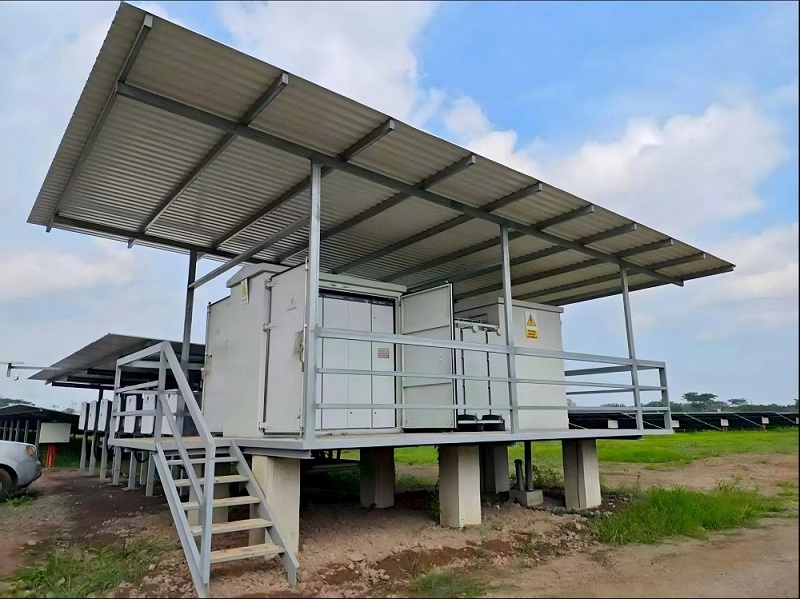
For overseas renewable energy projects, a substation cannot simply be designed according to electrical parameters.
Environmental conditions, transportation limitations, installation practices, corrosion resistance, temperature rise and long-term maintenance all need to be considered during the engineering stage.
For this coastal solar project in Guatemala, MIRACLE PE designed and supplied a customized 4MVA 34.5kV/0.69kV PV substation (solar transformer substation) for the project’s high-temperature, high-humidity and salt-spray environment.
The project required a balance between:
- High capacity
- High current
- Coastal corrosion resistance
- Thermal performance
- Compact transportation dimensions
- Fast site installation
- Long-term operational reliability
This made the project significantly different from a standard compact substation.
Project Overview
Project: Coastal Solar Power Project
Destination: Guatemala
Application: Photovoltaic / Solar Power Plant
Equipment: PV Substation / Compact Substation
Capacity: Up to 4MVA
Primary Voltage: 34.5kV
Secondary Voltage: 0.69kV
Installation Environment: Coastal area
Corrosion Protection: C5
Enclosure Protection: IP65
Transportation: Standard container shipping
The project included high-capacity units ranging from approximately 3MVA to 4MVA, designed for renewable energy applications.
Challenge 1: 34.5kV / 690V with High Capacity and High Current
The first challenge was the electrical configuration.
A transformer rated at approximately 3MVA to 4MVA with 34.5kV primary and 690V secondary produces a very high current on the low-voltage side.
For example, a 4MVA transformer at 690V generates low-voltage current of approximately:
3,347 A
This means the low-voltage system must be designed carefully.
The LV switchgear, busbars, cable connections, ventilation and internal temperature distribution all need to be considered as part of one integrated system.
For this reason, the project could not be treated as a conventional small-capacity box-type substation.
Challenge 2: Coastal Environment and Salt Spray Corrosion
The installation site is located in a coastal environment.
For electrical equipment installed near the sea, salt spray, humidity and high temperatures can significantly accelerate corrosion.
These environmental factors can affect:
- Enclosure steelwork
- Hinges and locks
- Fasteners
- Busbar connections
- Electrical terminals
- Surface coating
- Internal electrical components
- Long-term insulation reliability
To address this, the substation was designed with a C5 corrosion protection requirement.
C5 is intended for environments with very high corrosion risk, making it suitable for severe coastal or industrial conditions.
The enclosure protection requirement was also designed to meet IP65, providing enhanced protection against dust and water ingress.
Challenge 3: Temperature Rise in a High-Capacity PV Substation
High-capacity renewable energy substations often experience considerable internal heat generation.
This is especially important when several factors occur at the same time:
- Large transformer capacity
- High low-voltage current
- High outdoor ambient temperature
- Strong solar radiation
- Sealed or highly protected enclosure
- Coastal humidity
A high IP rating can improve environmental protection, but it also reduces natural ventilation.
This creates a design conflict:
Better sealing means more difficult heat dissipation.
For this project, thermal management became one of the key engineering considerations.
The final solution included internal circulation air conditioning for the low-voltage switchgear compartment.
This helps maintain acceptable internal temperatures while preserving the required enclosure protection level.
The objective was not simply to add cooling equipment, but to ensure that the complete system could comply with temperature-rise requirements under realistic site conditions.
Challenge 4: Container Shipping Efficiency
For export projects, transportation design can directly affect the total project cost.
A substation that performs well electrically but requires oversized transportation may create unnecessary logistics cost.
Therefore, transportation dimensions were considered from the beginning of the design.
One of the optimized designs used for this project was approximately:
5.8 × 2.2 × 2.45 m
for a 3.5MVA / 36kV-class unit.
The dimensions were carefully controlled so that:
Two units could fit into one 40-foot standard container.
This significantly improves container utilization and reduces sea freight cost.
For overseas projects, MIRACLE PE considers transportation not as an afterthought, but as part of the engineering process.
Challenge 5: Modular Design for Faster Site Installation
Renewable energy projects often require fast installation and commissioning.
Reducing on-site work can help customers save:
- Installation time
- Labor cost
- Crane time
- Site assembly risk
- Commissioning time
Therefore, the substation was designed with a modular and pre-assembled concept.
As much installation and integration work as possible was completed before shipment.
This helps the customer reduce the amount of field work required after the equipment arrives at the solar project site.
Final Engineering Solution
After evaluating the electrical, environmental and transportation requirements, the final design focused on five areas:
1. High-Capacity Electrical Design
The transformer and low-voltage system were engineered for the high current associated with 690V output.
2. C5 Anti-Corrosion Protection
The enclosure and surface treatment were designed for severe coastal operating conditions.
3. IP65 Protection
The enclosure was designed to provide high protection against dust and water ingress.
4. Internal Thermal Management
The low-voltage switchgear compartment adopted internal circulation air conditioning to help meet temperature-rise requirements.
5. Container-Optimized Dimensions
The substation dimensions were optimized for standard container transportation, allowing efficient sea freight and easier overseas delivery.
Why This Project Matters
This Guatemala solar project demonstrates an important point:
A PV substation is not just a transformer placed inside an enclosure.
A successful design must consider the entire operating environment.
For overseas renewable energy projects, this includes:
- Electrical parameters
- Ambient temperature
- Salt spray
- Humidity
- Corrosion
- Temperature rise
- Transportation
- Installation
- Maintenance
- Local operating practices
At MIRACLE PE, we use a flexible engineering approach for export projects.
Instead of forcing every project into a standard model, we evaluate the real project conditions and adjust the design accordingly.
MIRACLE PE Experience in Latin American Renewable Energy Projects
MIRACLE PE provides customized transformer and substation solutions for customers in Latin America and other international markets.
Our experience includes equipment for:
- Solar power plants
- Renewable energy projects
- Industrial power distribution
- Utility distribution systems
- Commercial substations
- High-capacity transformer applications
For projects in Guatemala, the Dominican Republic, Mexico, Central America and the Caribbean, common engineering considerations include:
- 34.5kV distribution systems
- 690V low-voltage solar applications
- High ambient temperature
- Coastal corrosion
- Salt spray resistance
- Container transportation
- Outdoor installation
- Customized protection requirements
This experience helps us design equipment based on real project conditions rather than only standard catalogue configurations.
Need a Customized PV Substation?
If you are working on a solar or renewable energy project and require a customized substation, please send us:
- Required capacity
- Primary voltage
- Secondary voltage
- Frequency
- Vector group
- Short-circuit impedance
- Ambient temperature
- Installation altitude
- Corrosion environment
- Required IP rating
- Switchgear configuration
- Transportation restrictions
Our engineering team can review the requirements and propose a suitable solution.
MIRACLE PE
Customized Transformer & Substation Solutions for Global Power Projects
FAQ
What type of substation is suitable for a 34.5kV solar project?
For large photovoltaic projects, a customized PV substation typically integrates a step-up transformer, medium-voltage switchgear, low-voltage switchgear, protection and auxiliary systems. The final configuration depends on project capacity, voltage, environment and local standards.
Can a 4MVA transformer operate with a 690V secondary voltage?
Yes. However, the low-voltage current is very high, so the busbars, switchgear, cooling system and cable connections must be designed accordingly.
What corrosion protection is recommended for coastal solar projects?
For severe coastal environments, a high corrosion-resistance system such as C5 should be considered, depending on the project specification and site conditions.
Why is air conditioning used inside PV substations?
For large-capacity substations with sealed enclosures, internal cooling may be required to control switchgear temperature and help meet temperature-rise limits.
Can MIRACLE PE design substations for container transportation?
Yes. For overseas projects, dimensions and modular structure can be optimized for standard container shipping and easier on-site installation.